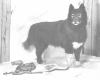
For more than 1,000 years a tribe of people known as the Chukchi have inhabited the Arctic coastal region of northern Siberia...a land where the extremes of winter make life a daily challenge just for survival. It is there that the Chukchi dog, the progenitor of today's Siberian Husky, was developed. Over many generations of breeding, the Chukchi developed the breed of dog that most suited their needs. Although their permanent home was inland, the Chukchi hunters worked primarily along the coast, with seal as their main food source. The hunters' catch was not so heavy as to require large dogs capable of pulling great weight. Instead, the Chukchi hunters needed a dog that could withstand extended exposure to the low temperatures, pull a light to moderate load quickly over long distances, and expend a minimum amount of energy in the process. The less energy the dog used on its work, the more it had left to protect it from the weather. Quick, small working dogs that were docile and intelligent enough to work in teams proved to be most suited to the work and terrain. They had to be hard, eager workers that had enough common sense and dedication to their task to keep from constantly tangling themselves in the lines of the sled. The Chukchi so valued their dogs that they often took them into their homes as guardians for their possessions and companions for their children. This, no doubt, accounts for much of the gentleness in the Siberian Husky personality. The Chukchi dog's most important trait was its instinct and desire to run, seemingly endlessly. Because of its moderate size, it was able to run far and fast, but it could not pull much weight. Therefore, teams of up to 20 dogs at a time were required to pull the hunters' load. The Chukchi were able to breed a dog that combined all these traits, and today's Siberian husky traces to those dogs. The fate of the Chukchi dog...and the birth of the Siberian Husky breed... are tied to several historical events, primarily in Russia. In the eighteenth century, Russian Cossacks began a march across Siberia to conquer the land and thereby attain all its resources, primarily fur. Most of the people living in the northern area were rather primitive tribal groups unable to compete with the advanced weaponry of the invading Russian army. The Chukchi people were able to withstand conquest, however, because their sled dogs always kept them ahead of the advancing military forces. They could not fight, but they could run - efficiently. The Chukchi were accustomed to the Siberian weather; the Russian soldiers were not, and suffered great losses. The Chukchi actually forced the Cossacks to give up their quest to conquer all of the northern Siberia. The Chukchi lured the Russian forces into a mountain pass, in which all escape routes were blocked. Using only sharpened rocks and spears, the Chukchi inflicted substantial casualties on Russians, who subsequently withdrew from the area. The Chukchi people and their dogs existed peaceably in Siberian for many years after this conflict. By the close of the nineteenth century, the Chukchi dog had been discovered by Alaskan traders, imported into the Northwest Territory, and renamed the Siberian Husky. The importation proved to be a very important event for the survival of the breed. In the early 1900's the monarchy in Russia was overthrown and replaced by a Communist regime, vowing to do away with all "bourgeois" and elite aspects of Russian life. By the 1930's, the forces of Communism reached the Arctic North. Because Chukchi dogs were revered highly and desired by the Chukchi people, those in the tribe that bred and maintained the finest dogs had assumed a leadership position and measure of wealth. Such people were viewed as hindrances to the forces of collectivization, and most were imprisoned or killed. In a matter of a few years, the Chukchi dog breed all but disappeared from Siberia. Unlike the breed's fate in Russia, the Siberian husky was taking hold in Alaska. Dog sledding had become not only a means of transportation, but also a popular sport for the adventurers who had journeyed north in search of gold. Local races quickly evolved into large events with numerous entries. A lawyer named Albert Fink undertook the task of regulating the dogsled events and helped to formalize the sport. The dogs used in the early races were primarily Alaskan sled dogs, which were originally bred to haul freight. They were larger and stronger than Siberian Huskies, and accordingly not as quick. They were, however, well adapted to the terrain and had great competitive spirit. In 1908 William Goosak, a Russian fur trader, entered a team of Chukchi dogs in the All-Alaska sled race from Nome. He hired a local driver familiar with the 408-mile course to lead the team, but the driver was not familiar with the Chukchi dog style of dog sledding. The team finished third against the experienced dogs and drivers, but the dogs' speed enthusiasm attracted a lot of attention to the breed. Many Chukchi dogs subsequently were imported from Siberian. The first sled driver to gain notoriety on the sled dog circuit using Siberian Huskies was a Norwegian named Leonhard Seppala, who had emigrated to Alaska early in the twentieth century. He inherited a well-trained team of huskies that had originally been scheduled to drive explorer Roald Amundsen to the North Pole. When the expedition was canceled due to the outbreak of World War I, the dogs were placed with Seppala. Over the next few years his Siberian Husky teams beat all comers in races throughout the Northwest. His huskies were all but unbeatable in the 25-mile Borden Cup Race that took place each year in Nome. In January 1925, Seppala and his huskies earned a place in history. That winter, and epidemic of diphtheria broke out in Nome and local doctors did not have adequate supplies of the required diphtheria serum. At the time, Nome was connected to the lower territories only by telephone; the nearest railroad station was more then 650 miles south near Anchorage. Seppala was chosen to go and collect the serum by dogsled, in a race against time. Seppala and his team headed south along the Tanana and Yukon Rivers and the Bering Sea...some of the most treacherous sections of Alaska's wilderness. A relay team comprised of 15 sleds and dogs was sent north with the serum to meet Seppala, as the world waited. On the day Seppala met up with the relay team (after mushing nearly 170 miles) he had already traveled more than 40 miles in blizzard conditions; he retrieved the serum and immediately headed back to Nome, posting another 40 miles before resting briefly. His team of 20 dogs amassed nearly 350 miles in this journey. The teams from the south ran relays of approximately 50 miles each and contributed greatly to the success of this mission. News reports of the feats of Seppala's dogs brought great acclaim to the breed. It created a demand for Siberian Huskies, especially by sledding enthusiasts in New England. Because the breeders in Alaska were unable to fill the request, they received, many interested fanciers imported dogs directly from Siberia. These proved to be the last substantial imports before the breed disappeared in its homeland. [ |
| The History of the Siberian Husky |
